Did you know that the air inside your home can be more polluted than the air outside? With dust, allergens, and microbes lurking in every corner, ensuring a healthy indoor environment is more important than ever.
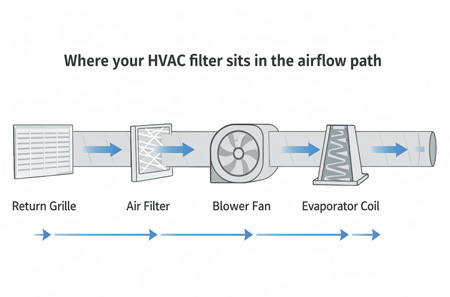
One key player in achieving cleaner air is the air filter, and understanding MERV ratings is essential for making an informed choice. But with so many options available, how do you select the right one to meet your specific needs?
In North Texas, your HVAC system moves a lot of air – especially during long, hot summers. So your air filter matters more than most homeowners realize. The filter helps protect your equipment and reduces the amount of dust and allergens that keep circulating through your home. In this article, you’ll know what MERV ratings mean, how they affect airflow, and how to choose a filter that improves air quality without making your system work harder than it needs to.
Key Points
- MERV measures filtration performance – specifically, how well a filter captures particles roughly 0.3 to 10 microns in size (higher MERV = better capture of smaller particles).
- Higher MERV can mean more airflow resistance. As filter efficiency goes up, pressure drop often increases, which can reduce airflow, increase fan energy use, or both if your system can’t handle it.
- Pick the highest MERV your system can comfortably accommodate. A MERV 13 filter is commonly recommended for better filtration, but if your HVAC can’t handle it, use the highest MERV that fits your system without stressing airflow.
- Check filters monthly during heavy-use seasons (yep, Texas summer counts) and replace when dirty – at minimum, every 3 months for many homes.
- Replacement timing depends more on thickness + conditions than MERV. Many manufacturers suggest 1-inch filters about every 3 months, while 4-inch+ media filters can last longer (often up to ~12 months) – but pets, dust, and runtime can shorten that.
What is a MERV rating?

MERV stands for Minimum Efficiency Reporting Value. It’s a standardized rating (based on ASHRAE testing) that lets you compare how well different filters capture airborne particles. In general, a higher MERV rating means the filter captures smaller particles more effectively, which can improve indoor air quality.
How MERV is determined
MERV is determined by measuring a filter’s performance against particles in the 0.3 to 10 micron range, using a lab test method developed by ASHRAE.
To make that size range feel real:
- Pet dander can range roughly from 0.1 to 25 microns (some of it falls right in the MERV test range).
- Mold spores are commonly 2 to 20 microns (many are in the 3–10 micron neighborhood).
- Allergy-producing pollen often averages around 25 microns, which is larger than the MERV test range—meaning pollen is usually easier to capture than the tiniest particles.
Knowing about MERV ratings helps you find the right balance between cleaner air and good airflow.
Higher MERV filters capture more and smaller particles, improving your indoor air quality. For example, a MERV 13 filter captures tiny particles like tobacco smoke and some bacteria, providing cleaner air for people with severe allergies or breathing problems. But these filters can also block airflow if your HVAC system is not made for them, making the system work harder and use more energy. So, the best choice is a MERV rating that makes your air cleaner without blocking too much airflow, so your health and your system both do well.
Choosing the Right MERV Rating for Your Home

Choosing the right MERV rating for your home involves several factors to consider. Factors such as local environment, health needs, and pets or smokers in the home can influence your decision. For example, homes in high-dust areas or heavy traffic may benefit from higher MERV ratings.
Health needs are key. Homes with members who have respiratory issues or allergies may need higher MERV-rated filters for better air quality. Homes with pets or smokers benefit from higher MERV filters to control odors and allergens.
Ensure that your HVAC system is compatible with the selected MERV (Minimum Efficiency Reporting Value) rating by consulting the system’s specifications in the HVAC manual. If your system cannot accommodate MERV-13A filters due to increased airflow resistance, choose the highest MERV-A-rated filter that your system can support without reducing operational efficiency.
MERV Ratings and Air Quality
Choosing the right MERV rating can greatly improve indoor air quality by capturing airborne pollutants. For most homes, a MERV 8 filter will provide sufficient filtration for good indoor air quality without restricting airflow too much. But specific air quality issues or allergies may require a higher MERV rating, like MERV 11 or MERV 13.
Higher MERV filters are capable of capturing smaller airborne particles, which leads to significantly improved indoor air quality. This increased filtration is particularly beneficial for homes with individuals who suffer from allergies or respiratory conditions, as these filters effectively trap common allergens such as pollen, mold spores, and dust mites.
For homes with pets or smokers, MERV 5-8 filters will improve air quality without severe airflow restrictions. For the best air quality, especially in environments with high levels of pollution, MERV 13 or higher filters are recommended.
Balancing Filtration and Airflow
Building on the discussion of how MERV ratings influence air quality, it is important to note that choosing a higher MERV filter may improve filtration but can also increase airflow resistance, making your HVAC system work harder. This increased strain can reduce the system’s efficiency and potentially shorten its life.
For example, a MERV 11 filter will restrict airflow more than a MERV 8 filter due to its higher density.
Balancing filtration efficiency and HVAC efficiency is key to the system’s longevity and better air quality.
Consider the following: Choose a MERV rating that doesn’t restrict airflow too much.
- This will optimize HVAC performance.
- Reduce wear and tear on the system.
Regularly checking and replacing filters is one way to achieve this. Make sure filters are not clogged and have the right MERV rating to avoid putting too much strain on the HVAC system and to get cleaner air.
Common MERV Ratings for Residential Use
MERV ratings 8-13 are generally recommended for homes to get good air quality without restricting airflow too much. This range provides good filtration for common household pollutants while ensuring efficient HVAC system operation and supporting optimal performance.
Homes with pets or allergies benefit from MERV 5-8 filters as these capture pet dander and other common allergens without significant airflow restriction. However, when considering higher-rated filters such as MERV 11, it is important to note that older HVAC units may not accommodate the increased resistance. Therefore, be sure to check the HVAC manual to confirm which MERV ratings are suitable for your system.
MERV Ratings vs. HEPA Filters
HEPA filters are considered the gold standard for air filtration. Key features include:
- MERV rating of 17 or higher
- Captures 99.97% of particles 0.3-1.0 microns
- Removes even the smallest airborne particles, including many pathogens, with high-efficiency particulate air technology.
However, HEPA filters are generally too dense for use in standard HVAC systems, which can restrict airflow and cause the system to overwork or even overheat. For example, installing a HEPA filter directly in a typical residential HVAC unit may cause a significant pressure drop, reducing system efficiency and potentially damaging components over time.
As a result, HEPA filters are most often used in standalone air purification units, which are designed for their high filtration capacity. In contrast, MERV-rated filters are suitable for most residential applications, while HEPA filters offer higher filtration efficiency but often require specialized installation to avoid compromising HVAC system performance.
Maintaining Your Air Filter
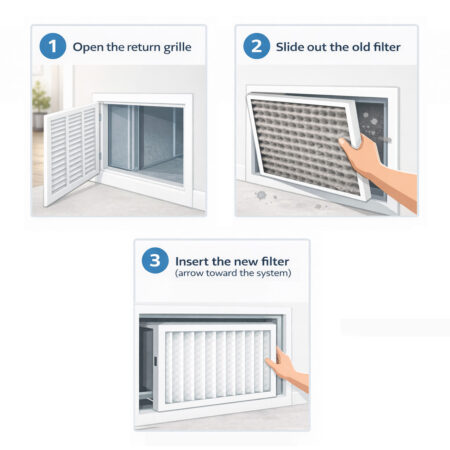
Regular HVAC system maintenance is key to good indoor air quality and efficient operation. Filter replacement timing depends more on filter thickness, system usage, and household conditions than on MERV rating alone.
As a general rule, check your air filter every month and change it when it looks dirty. Most 1-inch filters need to be changed every 1–3 months, while thicker 4–5 inch filters can last 6–12 months, depending on how much you use them and your home’s conditions.
Your calendar is a starting point – but real life is what clogs filters. In North Texas, filters often load up faster during:
- Spring pollen explosions
- Dusty winds/construction nearby
- Wildfire smoke days
- After a remodel (drywall dust is brutal)
The Department of Energy is pretty clear: skipping maintenance on filters (and coils/fins) causes performance to decline and energy use to rise. A simple field test: hold the filter up to a bright light – if light barely passes through, it’s time (even if it’s “not due” yet).
Higher MERV Ratings on HVAC Systems
Many HVAC systems are limited to MERV 8 or MERV 9 filters due to airflow restrictions caused by higher-rated filters. Using higher MERV filters will increase energy bills as the system has to work harder. Also, the lifespan of HVAC components can be reduced when higher MERV filters are used without proper adjustments.
Higher MERV filters can have the following impact on HVAC systems:
- They can cause motor and heat exchanger overheating due to reduced airflow.
- HVAC systems may need rebalancing or motor speed adjustments to accommodate a tighter MERV filter.
- While higher MERV ratings capture more particles, they may also compromise airflow.
- Reduced airflow makes the HVAC system work harder and potentially increases energy costs.
Benefits of Choosing the Right MERV Rating
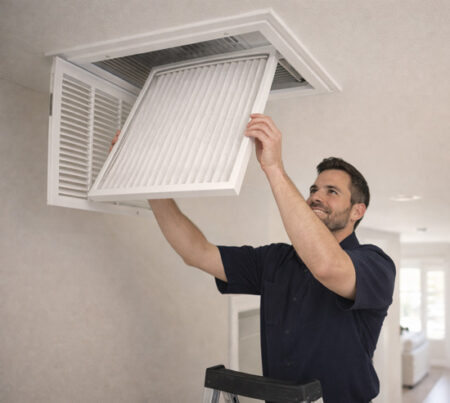
Choosing the right MERV rating gives better filtration of airborne particles and better air quality. Higher MERV ratings capture more allergens and particulates, dramatically improving air quality. This can lead to fewer health-related expenses in the long run due to better air conditions.
Choosing the right MERV rating balances cleaner air with healthy airflow, helping your system operate efficiently and potentially lowering energy use. It can also reduce dust buildup inside the equipment, potentially leading to fewer maintenance headaches.
The right MERV rating can improve residents’ long-term health and safety by filtering out harmful contaminants.
Conclusion
In summary, choosing the right MERV rating for your home is key to maintaining optimal indoor air quality and HVAC system efficiency. By considering the local environment, your health needs, and your HVAC system’s capabilities, you can make an informed decision that benefits both your health and your home’s air quality. Remember, regular HVAC system maintenance and timely replacement of air filters are key to sustaining these benefits.
FAQs
MERV stands for Minimum Efficiency Reporting Value, which measures a filter’s effectiveness in capturing airborne particles. Understanding MERV ratings helps in selecting the right air filter for optimal indoor air quality.
You should check your air filter every month and replace it when it looks dirty. Most homes with standard 1-inch filters need a replacement every 1–3 months, especially during hot Texas summers when the AC runs nonstop.
If your system uses a thicker 4–5 inch media filter, it may last 6–12 months, depending on dust levels, pets, allergies, and how often your system runs. Replacing your filter on time helps maintain healthy indoor air and keeps your HVAC system running efficiently.
Using a higher MERV filter can damage your HVAC system by restricting airflow, potentially increasing energy costs and shortening the lifespan of its components. You need to choose a filter that balances air quality and system efficiency.
HEPA filters are better at capturing smaller particles than MERV-rated filters, as they have a MERV rating of 17 or higher. But they require standalone units, which may not be compatible with standard HVAC systems.
For homes with pets or allergies, MERV 5-8 is recommended, MERV 11 or 13 for severe allergies.