Why Does My AC Breaker Keep Tripping? 7 Causes Texas Homeowners Should Know
When your air conditioner suddenly stops cooling and you find a tripped breaker in the electrical panel, the breaker itself may not be the real problem.
A circuit breaker is a safety device. It shuts off power when the electrical circuit is experiencing an abnormal condition such as excessive current or an electrical fault. If an AC breaker trips repeatedly, the system should be inspected rather than continually reset. Carrier advises against resetting a breaker again if it immediately trips, while Trane recommends professional diagnosis when an HVAC breaker has tripped.
In North Texas, air conditioners operate for long periods during the cooling season. Problems with condenser airflow, motors, capacitors, compressors, wiring, or the electrical circuit can become especially noticeable when the system is working hard.
Here are seven common reasons an AC breaker may keep tripping — and what the timing of the trip can tell you.
⚡ First: Is It the Outdoor AC Breaker or the Indoor HVAC Breaker?
A typical central HVAC system may have separate electrical circuits for the indoor and outdoor equipment.
| Breaker That Trips | Equipment It May Supply | Possible Problems |
|---|---|---|
| Outdoor AC / Condenser | Compressor, condenser fan motor, capacitor, contactor | Compressor problem, fan failure, capacitor failure, short circuit, dirty condenser |
| Furnace / Air Handler | Blower motor, control board, electric heat components | Blower motor problem, electrical short, wiring or control problem |
| Breaker trips immediately | Electrical circuit or component | Short circuit, grounded component, compressor electrical failure |
| Breaker trips after running | Equipment under operating load | Overheating motor, compressor load, condenser airflow problem, electrical connection |
The timing doesn’t provide a complete diagnosis, but it can be an important clue.
🔴 Important
Do not keep resetting an AC breaker that repeatedly trips.
A breaker that immediately trips again can indicate a deeper electrical fault. Copeland also warns that a tripped breaker or blown fuse may indicate an electrical fault in the compressor or system, and energizing a compressor with an electrical fault can create additional hazards.
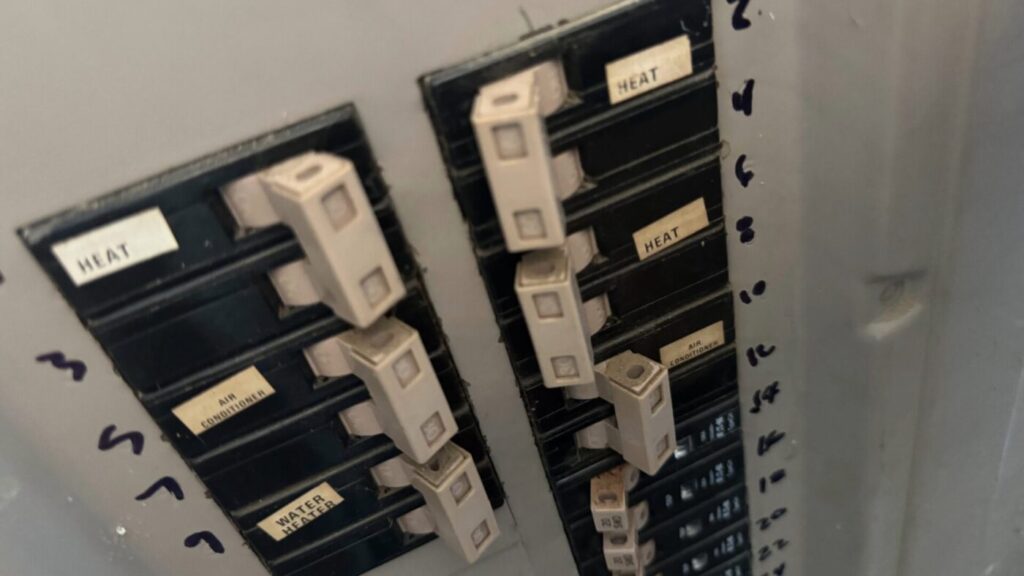
A tripped AC breaker is a symptom. The underlying problem may be somewhere in the outdoor unit, compressor, fan motor, wiring, or electrical circuit.
1. Dirty or Blocked Condenser Coil
Your outdoor condenser has to move a large amount of outdoor air through its coil to reject the heat removed from your home.
Grass clippings, cottonwood, pollen, leaves, dust, pet hair and other debris can restrict airflow through the condenser coil.
When condenser airflow decreases, the system has to work harder to reject heat. Trane notes that a dirty condenser coil can reduce system performance and force the cooling system to work harder; heavy dirt buildup can also contribute to system shutdown.
👀 What you may notice
- AC runs longer than usual
- Outdoor unit sounds louder
- Cooling performance decreases
- Condenser air feels extremely hot
- AC shuts down during the hottest part of the day
- Breaker trips after the system has been operating for some time
✅ What a homeowner can check
Look at the outside of the condenser.
If the coil is completely covered with grass, leaves or debris, airflow may be restricted. Keep vegetation and large objects away from the outdoor unit. Trane recommends maintaining clearance around the condenser and keeping debris away from it.
🔴 What not to do
Do not remove electrical panels or use a pressure washer on the condenser coil. High-pressure water can damage coil fins.
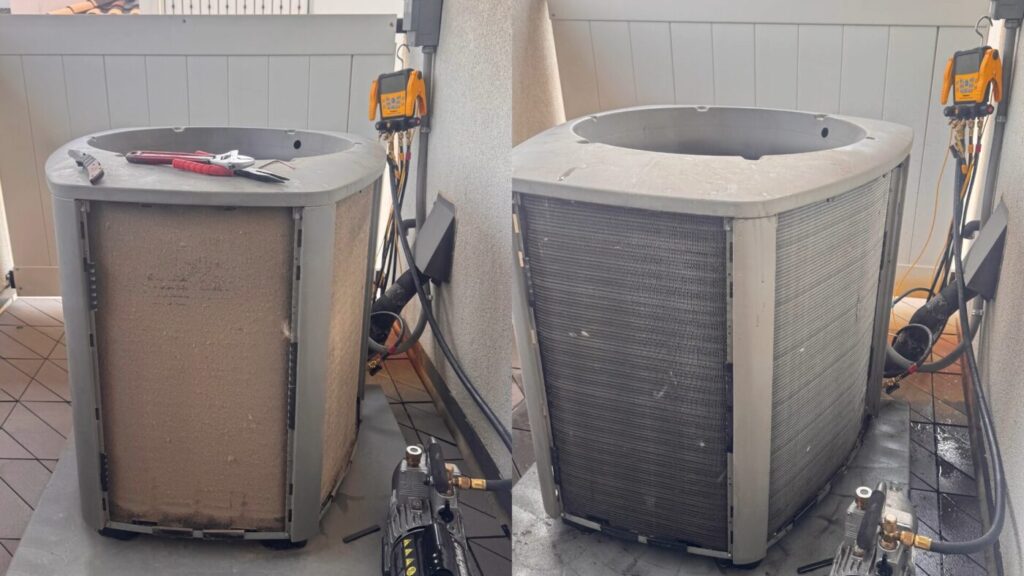
A heavily restricted condenser coil reduces heat transfer and makes the cooling system work harder.
2. Condenser Fan Motor Problem
The condenser fan pulls outdoor air through the coil and moves heat away from the refrigerant.
If the fan stops, slows down, overheats or cannot start properly, the outdoor unit can quickly develop abnormal operating conditions.
Common causes of a condenser fan not spinning include a failed capacitor, burned-out fan motor, electrical problems or wiring/control issues.
⚠️ Warning signs
- Compressor runs but outdoor fan does not
- Fan starts slowly
- Fan stops while the compressor continues running
- Motor is unusually noisy
- Burning smell
- Outdoor unit becomes extremely hot
- Breaker trips after several minutes
🔴 Compressor running + fan stopped = shut the AC off
Do not continue operating an outdoor unit with a condenser fan that isn’t working correctly.
The condenser depends on airflow to reject heat.
3. Weak or Failed AC Capacitor
Residential AC systems commonly use capacitors to help compressor and fan motors start and operate.
A failing capacitor can prevent a condenser fan or compressor from starting normally. Carrier lists a faulty capacitor among the potential causes when an AC will not start and among common causes of a condenser fan that will not spin.
Common capacitor symptoms
🔊 Humming but no start
🌀 Outdoor fan won’t spin
⏱️ Delayed startup
🔁 Intermittent starting
🔥 Motor overheating
⚡ Breaker tripping during startup
A capacitor problem can sometimes look like a failed compressor or fan motor, which is why electrical testing matters.
❌ Don’t open the electrical compartment
AC capacitors can retain an electrical charge even after the system has been turned off.
Capacitor diagnosis and replacement should be performed with appropriate electrical testing and safety procedures.
QUICK CONTRAST
| Healthy Startup | Problem Startup |
|---|---|
| ✅ Compressor starts promptly | ❌ Compressor hums |
| ✅ Fan reaches normal speed | ❌ Fan struggles to start |
| ✅ Breaker remains on | ❌ Breaker trips |
| ✅ Normal operating sound | ❌ Buzzing, humming or repeated attempts |
| ✅ System continues cooling | ❌ System shuts down |
4. Compressor Is Overheating, Locked or Electrically Damaged
The compressor is one of the largest electrical loads in a residential air-conditioning system.
A compressor that is mechanically difficult to start, overheating, drawing excessive current, or electrically damaged can cause repeated breaker trips.
Carrier identifies repeated breaker tripping as a possible sign of a compressor that is overheating or drawing too much electrical power. Copeland states that a tripped breaker may indicate an electrical fault within a compressor and recommends that technicians rule out electrical faults before energizing it.
Compressor-related problems can include
- Excessive starting current
- Mechanical lockup
- Internal overheating
- Winding-to-ground electrical fault
- Internal motor damage
- Abnormal operating pressures
- Damaged compressor terminals
⚡ A very important clue
Breaker trips immediately when the compressor tries to start
This is more concerning than a breaker that trips after hours of operation.
An HVAC technician may need to test:
- Compressor winding resistance
- Resistance to ground
- Starting and running amperage
- Supply voltage
- Capacitor
- Contactor
- Refrigerant operating conditions
🚨 Immediate breaker trip?
Do not repeatedly reset it.
This is one of the situations where the system should remain off until the electrical fault is diagnosed.
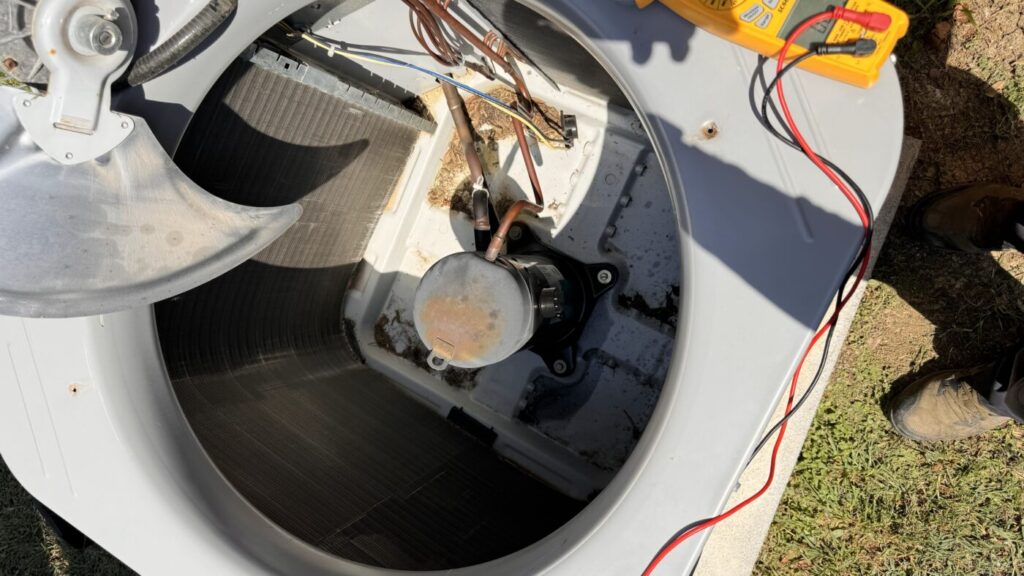
Repeated breaker trips can be caused by a compressor electrical or mechanical problem. Proper testing is required before condemning the compressor.
5. Burned Wiring, Contactor or Disconnect
An AC condenser operates in a harsh outdoor environment while carrying significant electrical current.
Over time, electrical connections can deteriorate.
Possible problems include:
- Loose terminals
- Overheated connections
- Burned wire insulation
- Damaged contactor
- Burned disconnect
- Corroded connections
- Shorted wiring
NFPA lists frequent circuit-breaker tripping, warm or discolored electrical components, burning odors and other electrical abnormalities among signs that should receive attention.
🔥 Possible warning signs
- Burned-plastic smell
- Buzzing or arcing sound
- Discoloration around the disconnect
- Melted insulation
- Breaker trips unpredictably
- Outdoor unit loses power intermittently
🚫 Do not touch burned electrical components
If you smell burning or see melted wiring, shut the HVAC system off and have it inspected.
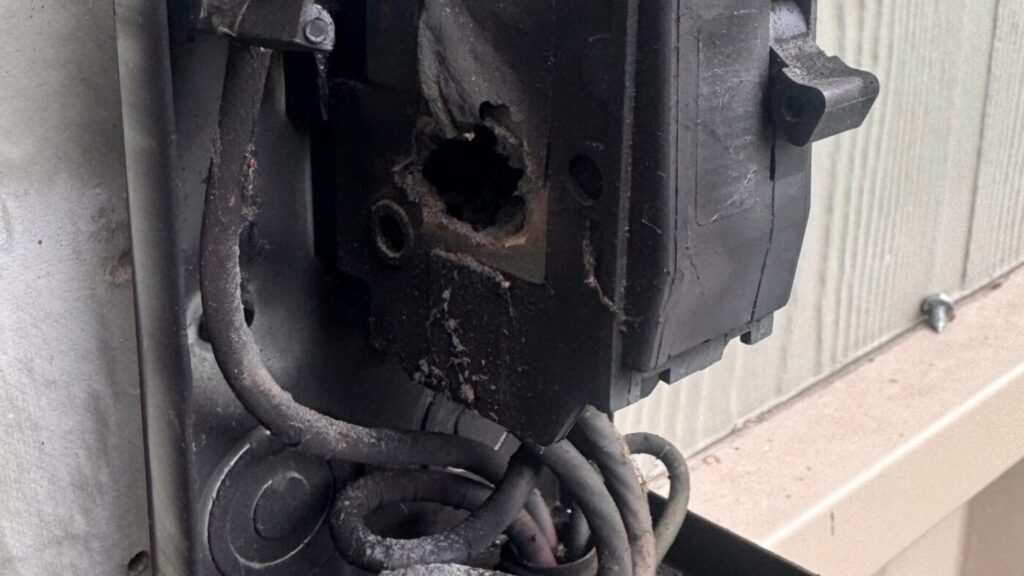
Loose or overheated electrical connections can damage disconnects, wiring, and HVAC components and may cause the circuit breaker to trip.
6. Abnormally High Operating Load
Sometimes the electrical components themselves are not the original cause.
An AC compressor may be forced to operate under abnormal conditions because the refrigeration system cannot reject heat properly.
Possible contributors include:
- Restricted condenser airflow
- Condenser fan problem
- Extremely dirty condenser
- Incorrect refrigerant charge
- Refrigerant restriction
- Other abnormal refrigeration-system conditions
The compressor compresses refrigerant into a high-pressure, high-temperature gas before sending it through the condenser, where heat must be rejected to the outdoor air.
This is why technicians don’t diagnose repeated breaker trips simply by replacing the breaker.
The technician should determine why the current became excessive in the first place.
7. The Breaker or Electrical Circuit Has a Problem
Not every recurring AC breaker trip originates inside the HVAC equipment.
The electrical circuit itself may have a problem.
Examples include:
- Deteriorated circuit breaker
- Loose breaker connection
- Damaged wiring
- Improper electrical connection
- Circuit sized incorrectly for the installed equipment
- Electrical-panel problem
The National Electrical Code is the primary U.S. benchmark for electrical-system design and installation, and HVAC equipment must be supplied by electrical protection appropriate for the equipment and circuit.
⚠️ Don’t simply install a larger breaker
A larger breaker is not a solution for an AC that keeps tripping.
The breaker and conductors must be properly matched to the equipment’s electrical requirements.
Increasing breaker size without verifying the circuit and manufacturer’s equipment requirements can defeat the intended overcurrent protection.
⏱️ WHEN Does Your AC Breaker Trip?
This information can be extremely useful when you call an HVAC company.
| When It Trips | What It May Suggest |
|---|---|
| Immediately when AC turns on | Short circuit, grounded component, compressor electrical problem |
| When compressor tries to start | Capacitor, compressor startup problem, voltage/electrical issue |
| After 5–30 minutes | Motor overheating, condenser airflow problem, compressor load |
| Only during very hot afternoons | System operating under heavy load; condenser, fan or compressor condition should be checked |
| Randomly | Loose connection, intermittent motor/electrical component or breaker problem |
| After power outage/storm | Electrical event may have affected the system; recurring trips require diagnosis |
These are diagnostic clues, not definitive diagnoses. Measurements are required to identify the actual cause.
🟢 What You Can Check vs. 🔴 What Requires a Technician
| Homeowner Can Safely Check | Leave to an HVAC Professional |
|---|---|
| 🟢 Thermostat setting | 🔴 Compressor amperage |
| 🟢 Dirty air filter | 🔴 Capacitor testing |
| 🟢 Visible outdoor debris | 🔴 Compressor winding testing |
| 🟢 Whether outdoor fan is spinning | 🔴 Refrigerant pressures |
| 🟢 Which breaker has tripped | 🔴 Contactor testing |
| 🟢 Burning odor from a safe distance | 🔴 Opening electrical panels |
| 🟢 When the breaker trips | 🔴 Wiring and disconnect repair |
| 🔴 Breaker/circuit diagnosis |
Should You Reset the AC Breaker?
There is an important difference between a single isolated trip and a breaker that keeps tripping.
🟡 One-time trip
A one-time electrical event may occasionally trip a breaker.
Some manufacturer guidance allows a homeowner who is comfortable working at the electrical panel to reset a tripped breaker once.
🔴 Breaker trips again
Stop.
Carrier advises that if the breaker immediately trips again, you should not continue trying to reset it because a deeper electrical fault may be present. Trane takes an even more conservative approach and recommends contacting an HVAC professional when the HVAC breaker has tripped.
Repeated resetting does not repair the problem.
AC Breaker Tripping vs. AC Simply Shutting Off
These two conditions are not the same.
| AC Shuts Off | Breaker Trips |
|---|---|
| May be thermostat related | Electrical protection has opened the circuit |
| Could be condensate safety switch | May indicate excessive current or electrical fault |
| Could be compressor thermal protection | Requires determining why breaker opened |
| Power may still be present | Power to the circuit is interrupted |
| May restart automatically | Breaker generally requires manual reset |
Knowing which condition is actually occurring can significantly narrow the diagnosis.
Can a Dirty Air Filter Trip the Outdoor AC Breaker?
Usually, a dirty indoor air filter by itself is not the first thing we would suspect when the outdoor condenser breaker repeatedly trips.
However, severely restricted indoor airflow can cause other HVAC problems. Trane notes that clogged filters can reduce airflow and contribute to frozen evaporator coils.
That is why a complete diagnosis should look at both the electrical system and overall HVAC operation rather than assuming the breaker itself is bad.
Can a Bad Capacitor Cause an AC Breaker to Trip?
It can.
A failed capacitor may prevent a compressor or condenser fan motor from starting correctly, and manufacturers identify faulty capacitors as common causes of AC starting and condenser-fan problems.
The capacitor should be tested rather than replaced based only on appearance.
Can a Bad Compressor Trip the Breaker?
Yes.
A compressor that is overloaded, overheating, mechanically locked or electrically damaged can cause repeated breaker trips. Carrier identifies repeated breaker tripping as a potential compressor-failure symptom, and Copeland specifically warns technicians to investigate compressor electrical faults before re-energizing the equipment.
This is one reason repeatedly resetting the breaker is not a good troubleshooting method.
Does a Tripped Breaker Mean I Need a New AC?
Not necessarily.
A breaker trip could be caused by something relatively repairable such as:
✅ Capacitor
✅ Condenser fan motor
✅ Contactor
✅ Dirty condenser coil
✅ Damaged electrical connection
Or it could involve a more serious problem such as:
❌ Grounded compressor
❌ Major compressor failure
❌ Significant electrical damage
The correct decision depends on the diagnosis, repair cost, system age, refrigerant type, warranty coverage and overall condition of the HVAC equipment.
🔧 How an HVAC Technician Diagnoses a Breaker-Tripping AC
A professional diagnosis may include:
- Inspecting the condenser and electrical compartment
- Checking the condenser coil and airflow
- Testing the capacitor
- Inspecting the contactor and disconnect
- Checking supply voltage
- Measuring compressor and fan-motor current
- Testing compressor windings
- Checking the compressor for an electrical fault to ground
- Inspecting wiring and terminals for overheating
- Evaluating refrigerant operating conditions when necessary
- Comparing measured electrical values with the equipment specifications
- Determining whether the fault is in the HVAC equipment or electrical circuit
The goal isn’t simply to get the breaker to stay on.
The goal is to identify why it tripped.
⚡ The Bottom Line
An AC breaker that keeps tripping should not be ignored.
A breaker may be responding to a relatively straightforward problem such as a capacitor or dirty condenser coil — or it may be protecting the system from a serious compressor or electrical fault.
Remember:
🟢 Check the filter and visible outdoor airflow.
🟡 Pay attention to exactly when the breaker trips.
🔴 Don’t repeatedly reset a breaker.
🔴 Don’t open HVAC electrical compartments unless you’re qualified to work on the equipment.
⚡ If the breaker trips again, have the system professionally diagnosed.
AC Breaker Keeps Tripping in Dallas–Fort Worth?
Airmatics provides professional AC diagnostics and repair throughout Plano, Frisco, Allen, Dallas and surrounding North Texas communities. Airmatics’ current service-area pages list HVAC repair, maintenance and installation services throughout the Dallas–Fort Worth area.
If your AC breaker keeps tripping, our technicians can test the electrical components, compressor, motors and operating conditions to determine the actual cause before replacing parts.
Schedule AC service with Airmatics and get the problem properly diagnosed before a small electrical or mechanical issue becomes a major repair.
Frequently Asked Questions
Why does my AC breaker trip immediately?
An immediate trip can indicate a short circuit, grounded electrical component or major compressor/electrical fault. Do not repeatedly reset it.
Why does my AC run for 10 minutes and then trip the breaker?
A delayed trip can point toward a component that begins overheating under load, a condenser fan problem, restricted condenser airflow, compressor load or another operating issue. The system needs electrical and refrigeration-side testing to determine the cause.
Can a dirty condenser cause the breaker to trip?
A dirty condenser restricts airflow and makes the cooling system work harder. Heavy buildup can contribute to abnormal operation and even system shutdown.
Should I replace the breaker if my AC keeps tripping it?
Not before diagnosing the HVAC equipment and electrical circuit. Replacing a breaker without identifying the reason it trips may leave the original fault unresolved.
Can I install a bigger breaker for my AC?
No. Breaker and conductor sizing must match the electrical requirements of the HVAC equipment and circuit. A larger breaker should never be used simply to stop nuisance tripping.
Is a breaker that trips once an emergency?
Not necessarily. But if it trips again, trips immediately, you smell burning, see electrical damage or the outdoor equipment is behaving abnormally, leave the system off and have it inspected.
Will resetting the breaker damage my AC?
Repeatedly energizing equipment with an unresolved electrical fault can be dangerous. Copeland specifically warns that re-energizing a compressor with an electrical fault can create hazardous conditions.