Your air conditioner is running normally one day. The next day, you hear a humming sound from the outdoor unit, the fan isn’t moving, or the AC simply won’t start.
One of the first components an HVAC technician may test is the AC capacitor.
Capacitor failure is a common electrical problem in residential air-conditioning systems, especially in climates like North Texas where outdoor equipment operates for long hours in high summer temperatures.
A bad capacitor can prevent the condenser fan or compressor from starting correctly. In some cases, continuing to run the system with a weak capacitor can place additional stress on expensive motors and the compressor.
The good news is that capacitor failure is usually a repairable problem and does not automatically mean you need a new AC system.
Here’s what Texas homeowners should know about AC capacitor symptoms, replacement cost, diagnosis and failure.
⚡ What Does an AC Capacitor Do?
An AC capacitor is an electrical component that stores electrical energy and helps create the electrical conditions needed for certain HVAC motors to start and operate properly.
Your air conditioner may use capacitors for components such as:
- Compressor
- Condenser fan motor
- Indoor blower motor
- Certain additional starting circuits
Carrier describes capacitors as critical components that provide starting support and help motors continue operating efficiently.
Without the correct capacitor, a motor may:
❌ Struggle to start
❌ Hum without running
❌ Run hotter than normal
❌ Draw abnormal current
❌ Shut down
❌ Fail completely
🔋 Common Types of HVAC Capacitors
There are several different capacitor configurations.
| Capacitor Type | Purpose | Where You May Find It |
|---|---|---|
| Run capacitor | Supports a motor while it operates | Fan motors, compressors, blowers |
| Start capacitor | Provides additional starting torque for a short period | Compressor starting circuits |
| Dual-run capacitor | Combines compressor and condenser-fan capacitor functions | Many residential outdoor condensers |
| Blower capacitor | Supports certain indoor blower motors | Furnace or air handler |
Carrier identifies start, run and dual-run capacitors as the three common residential HVAC capacitor configurations.
A typical dual-run capacitor may have three terminal groups:
C — Common
FAN — Condenser fan motor
HERM — Compressor
The capacitor must have the correct capacitance rating in microfarads (µF) and the proper voltage rating for the equipment.
Installing the wrong capacitor is not an acceptable substitute simply because it physically fits.
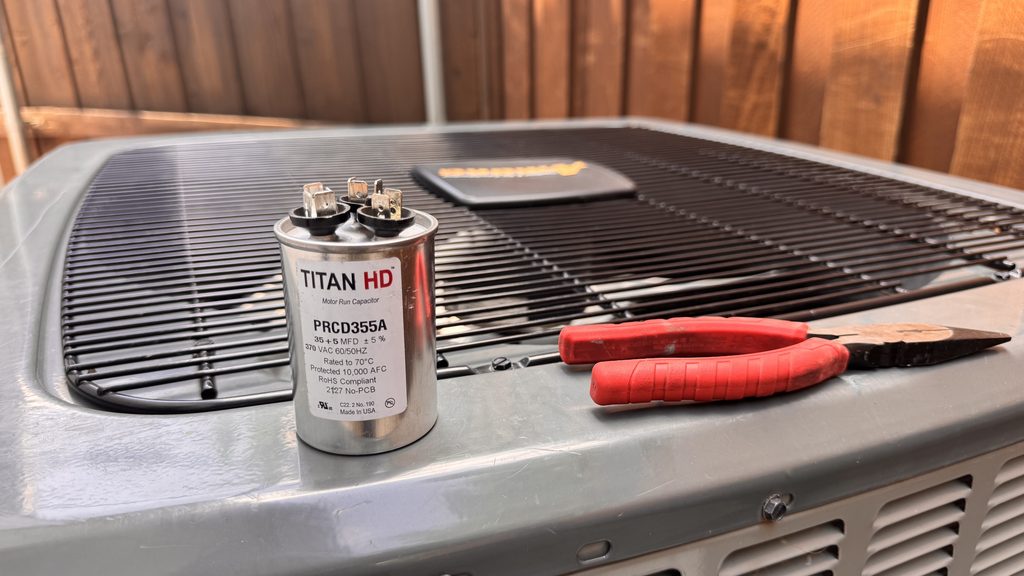
A dual-run capacitor supports both the compressor and condenser fan motor in many residential AC systems.
7 Signs Your AC Capacitor May Be Failing
A capacitor doesn’t always fail instantly.
It can gradually become weak before eventually falling outside its required electrical specification.
Here are some common symptoms.
1. Outdoor AC Unit Hums but Won’t Start
This is one of the classic capacitor-related symptoms.
The thermostat calls for cooling.
You hear:
Hmmmmmm…
But the outdoor unit doesn’t start normally.
The motor may be receiving electrical power but not getting the electrical support it needs to start properly.
Carrier identifies humming from the outdoor unit as a common symptom associated with capacitor failure.
⚠️ Important
Humming does not automatically prove the capacitor is bad.
Similar symptoms can occur with:
- Failed compressor
- Locked compressor
- Failed fan motor
- Contactor problem
- Low voltage
- Wiring problem
That’s why the capacitor should be measured, not simply replaced based on sound.
2. Outdoor Fan Isn’t Spinning
Another common complaint is:
“My inside AC is running, but the outside fan isn’t moving.”
A weak or failed condenser-fan capacitor can prevent the fan motor from starting properly.
Carrier lists a malfunctioning run capacitor as one possible cause when an outdoor AC fan isn’t spinning, particularly when the motor is humming.
But a stopped fan can also be caused by:
- Failed fan motor
- Contactor problem
- No high-voltage power
- Broken wiring
- Control problem
🔴 Don’t do the “stick test”
You may find online videos suggesting that homeowners push an AC fan blade with a stick to see whether it starts.
We do not recommend this.
Outdoor HVAC equipment contains high-voltage electrical components and moving mechanical parts. Shut the system off and have the problem properly tested.
3. Compressor Won’t Start
A dual-run capacitor commonly supports both the condenser fan motor and compressor.
It is therefore possible for:
✅ The fan to run
while
❌ The compressor doesn’t start.
You may hear the compressor attempting to start or periodically clicking as internal protection opens.
A compressor that repeatedly tries to start under abnormal electrical conditions can overheat.
⚖️ IMPORTANT CONTRAST
Fan Running Does NOT Mean the Outdoor Unit Is Working Properly
| What You See | What May Actually Be Happening |
|---|---|
| Fan running normally | Compressor may still be off |
| Air coming from condenser | Refrigerant may not be circulating |
| Outdoor unit making noise | Compressor may be attempting unsuccessfully to start |
| Indoor blower running | Outdoor cooling system may not be operating |
If the house isn’t cooling, seeing the fan rotate does not confirm that the compressor is operating.
4. AC Starts Slowly or Struggles to Start
A healthy residential AC normally has a definite startup.
A weakening capacitor may produce:
- Delayed startup
- Repeated starting attempts
- Humming before startup
- Fan starting slowly
- Compressor struggling at startup
Carrier notes that capacitor problems can interfere with compressor and fan-motor starting.
This symptom should not be ignored simply because the AC eventually starts.
5. AC Starts and Stops Frequently
Frequent starting and stopping is known as short cycling.
A weak capacitor is one possible cause because the compressor or fan may have difficulty maintaining normal operation.
Carrier lists frequent cycling among symptoms associated with a failing capacitor.
However, short cycling can also result from:
- Refrigerant problems
- Oversized equipment
- Thermostat problems
- Dirty condenser
- Frozen evaporator coil
- Electrical controls
- Compressor overheating
A capacitor test should therefore be part of a diagnosis—not the entire diagnosis.
6. AC Blows Warm Air
A failed compressor capacitor can produce a confusing situation:
🌀 Indoor blower works
🌬️ Air comes from vents
❌ But the air isn’t cold
The thermostat and furnace blower may be functioning normally while the outdoor compressor isn’t running.
Carrier includes reduced cooling or warm-air symptoms among possible capacitor-failure indicators.
7. Capacitor Is Bulging or Leaking
Sometimes capacitor failure is visible.
A damaged capacitor may have:
- Swollen or domed top
- Oil leakage
- Corrosion
- Burned terminals
- Heat damage
- Ruptured casing
Carrier recommends visually inspecting capacitors for swelling, leakage and corrosion as part of professional diagnosis.
But appearance isn’t enough
A capacitor can look completely normal and still test below specification.
That’s why technicians measure capacitance in microfarads.
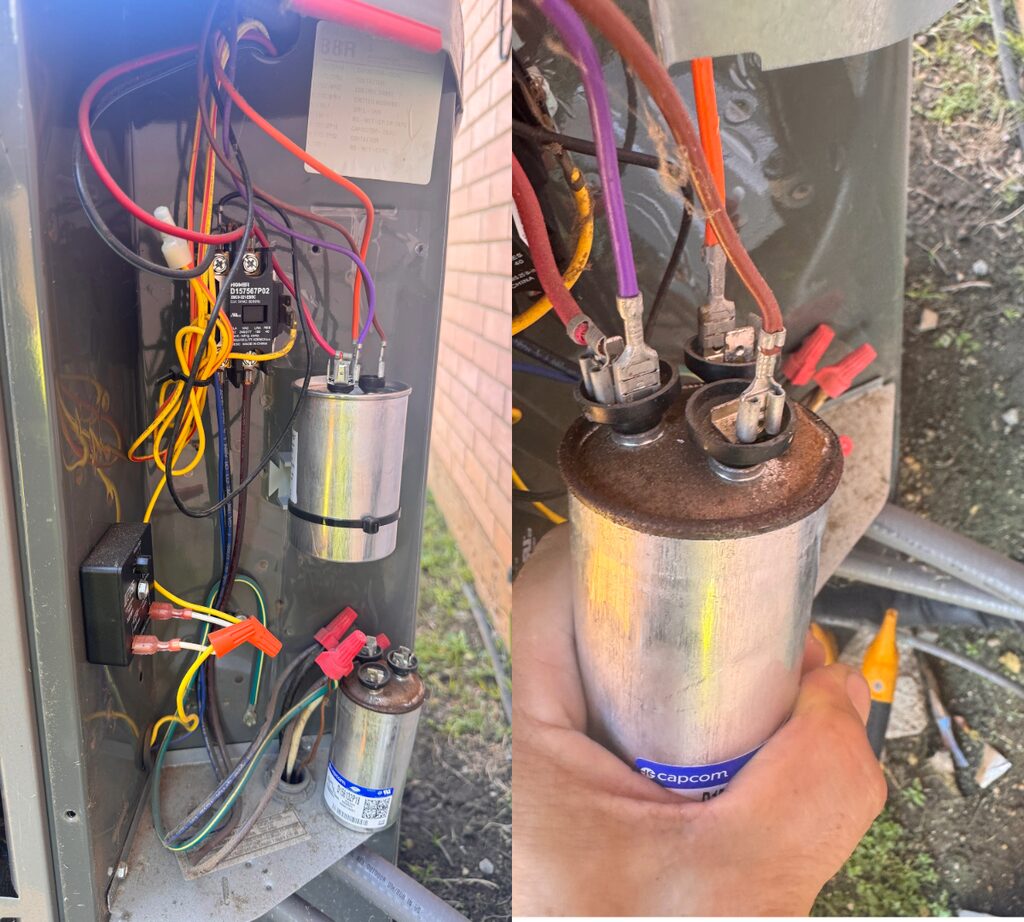
Left:
✅ Normal capacitor
Right:
❌ Bulged or leaking capacitor
A failed capacitor may visibly swell or leak, but many weak capacitors look normal and must be electrically tested.
🟢 Healthy Capacitor vs. 🔴 Weak Capacitor
| Healthy System | Possible Capacitor Problem |
|---|---|
| 🟢 Compressor starts normally | 🔴 Compressor hums or struggles |
| 🟢 Fan starts immediately | 🔴 Fan doesn’t start |
| 🟢 Normal startup sound | 🔴 Extended humming |
| 🟢 Continuous cooling | 🔴 Intermittent cooling |
| 🟢 Normal motor operation | 🔴 Motor overheating |
| 🟢 Capacitor within µF tolerance | 🔴 Capacitance below specification |
How Does an HVAC Technician Test an AC Capacitor?
A technician shouldn’t diagnose a capacitor simply by looking at it.
Testing normally involves safely disconnecting electrical power and measuring the capacitor’s actual capacitance.
Capacitance is measured in:
µF — microfarads
For example, a dual-run capacitor might be rated:
45/5 µF ±6%
This means one section supports the compressor and the other supports the condenser fan motor.
The measured value should remain within the manufacturer’s specified tolerance.
Carrier notes that HVAC technicians typically evaluate capacitor condition using a multimeter and that tolerances are commonly around ±5% or ±6%, depending on the capacitor specification.
Example
Suppose a capacitor is labeled:
45/5 µF ±6%
But testing shows:
Compressor side: 34 µF ❌
Fan side: 4.9 µF ✅
The fan portion may still be acceptable while the compressor portion has become significantly weak.
The capacitor should be evaluated against its actual rating, not whether the AC happens to still be running today.
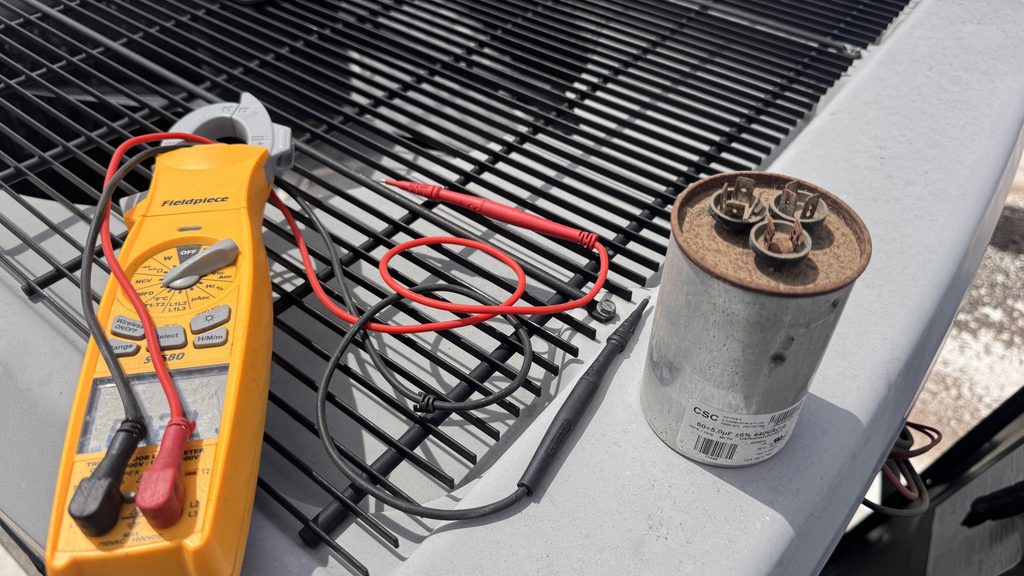
Capacitor condition should be confirmed by measuring capacitance and comparing the result with the component’s rated µF tolerance.
Can a Weak Capacitor Damage the Compressor?
Potentially, yes.
A weak capacitor can create difficult starting or operating conditions for the motor it supports.
Carrier warns that continuing to operate an AC with a bad capacitor can place additional stress on the compressor and fan motors.
A capacitor is inexpensive compared with:
- Compressor replacement
- Condenser fan motor replacement
- Complete outdoor-unit replacement
This is why capacitor testing is useful during HVAC maintenance.
A capacitor that is significantly below specification may be worth replacing before it results in a no-cooling call during extreme summer weather.
Why Do AC Capacitors Fail?
Several conditions can contribute to capacitor deterioration.
☀️ 1. Heat
Heat is one of the biggest enemies of electrical components.
The capacitor sits inside an outdoor condenser cabinet that can experience very high temperatures during a North Texas summer.
Carrier specifically identifies heat exposure as a factor that can shorten capacitor life.
⚡ 2. Electrical Stress
Voltage abnormalities, power disturbances and repeated difficult startups can place additional stress on electrical components.
🔄 3. Heavy AC Usage
Texas air conditioners may cycle thousands of times throughout their service life.
Every cooling cycle means another startup for the compressor and condenser fan.
🌀 4. Motor Problems
Sometimes the capacitor isn’t the only problem.
A failing compressor or motor may be operating under abnormal conditions.
Replacing the capacitor without checking the motor can result in another failure.
🔧 5. Incorrect Replacement Capacitor
Capacitance must match the equipment specification.
For example:
45 µF should not simply be replaced with 40 µF or 50 µF because that’s what happens to be available.
The technician should match the correct:
- µF rating
- Voltage rating
- Configuration
- Application
Carrier specifically warns that incorrect microfarad or voltage ratings can damage equipment.
📳 6. Age and Vibration
Electrical components deteriorate over time.
Carrier identifies both heat and vibration as factors affecting capacitor life.
How Long Does an AC Capacitor Last?
There isn’t one guaranteed lifespan.
Carrier states that AC capacitors may commonly last approximately 10–20 years, but also notes that heat exposure and operating conditions can significantly shorten their service life.
In a demanding cooling climate such as Dallas–Fort Worth, capacitors can fail considerably earlier than the HVAC system itself.
A 12-year-old air conditioner may have already had one or more capacitors replaced.
A relatively young system can also experience capacitor failure.
System age alone doesn’t determine capacitor condition.
Testing does.
💰 How Much Does AC Capacitor Replacement Cost?
Professional capacitor replacement cost varies substantially by location, system configuration and service conditions.
Published 2026 consumer pricing provides a useful general reference:
| Source | Published Professional Replacement Range |
|---|---|
| Carrier | Approximately $100–$400 |
| Angi 2026 data | Approximately $200–$400 average |
| HomeGuide | Approximately $250–$400 average |
Carrier reports a typical professional capacitor-replacement range of approximately $100–$400. Angi’s August 2026 cost guide places typical replacement around $200–$400, while noting that flat-rate professional service can reach roughly $300–$600 depending on circumstances. HomeGuide reports a $250–$400 average range.
Actual Dallas–Fort Worth pricing can vary.
Why Does Professional Capacitor Replacement Cost More Than the Capacitor Itself?
This is an important distinction.
When an HVAC company repairs an AC, the customer isn’t simply purchasing a metal cylinder.
The technician has to determine why the AC isn’t working and whether the capacitor is actually the failed component.
Professional service may include:
🔍 System diagnosis
⚡ Electrical safety procedures
📏 Capacitor testing
🔧 Correct part selection
🌀 Fan-motor evaluation
⚙️ Compressor evaluation
🔌 Electrical connection inspection
🧪 System startup testing
🌡️ Cooling-performance verification
🛡️ Labor warranty and company support
The part itself does not diagnose the system.
💡 PART PRICE vs. REPAIR SERVICE
| Buying a Capacitor | Professional Capacitor Repair |
|---|---|
| A component | Diagnosis + solution |
| No diagnosis | Technician identifies actual failure |
| No electrical testing | Electrical measurements performed |
| No compressor evaluation | Compressor operation checked |
| No fan-motor evaluation | Motor operation checked |
| No installation | Safe installation included |
| No performance verification | System tested after repair |
| No contractor warranty | Service warranty may apply |
A technician may discover that the capacitor is perfectly good and the actual problem is a:
- Compressor
- Fan motor
- Contactor
- Disconnect
- Wiring connection
- Control circuit
- Refrigeration problem
Replacing parts without diagnosis can become much more expensive than diagnosing the system correctly the first time.
What Affects AC Capacitor Replacement Cost?
Several factors can affect the final price.
Capacitor type
Dual-run, single-run and specialty capacitors can differ.
Equipment design
Some high-efficiency and variable-capacity equipment uses different electrical designs and may not use the same conventional capacitor arrangement found in basic single-stage condensers.
Diagnostic work
The technician may need to determine whether the capacitor caused the failure or is only one part of a larger electrical problem.
Additional damaged components
A burned terminal, damaged contactor, overheated wiring or failing motor may require additional work.
Emergency service
Night, weekend and emergency cooling calls may be priced differently.
Warranty
Equipment and repair warranty status can affect the final cost.
AC Capacitor vs. Contactor vs. Compressor Failure
These failures can produce similar symptoms.
Quick comparison
| Symptom | Capacitor | Contactor | Compressor |
|---|---|---|---|
| Outdoor unit won’t start | ✅ | ✅ | ✅ |
| Humming | ✅ | ✅ Possible | ✅ |
| Fan runs but compressor doesn’t | ✅ | Possible | ✅ |
| Compressor struggles to start | ✅ | Possible | ✅ |
| Burned electrical appearance | Possible | ✅ | Possible |
| Capacitor tests below µF | ✅ | ❌ | ❌ |
| Compressor winding problem | ❌ | ❌ | ✅ |
| Ground fault | ❌ | Possible wiring | ✅ Possible |
The symptoms overlap.
That’s why professional diagnosis involves measurements, not guessing.
Is a Hard Start Kit the Same as a Capacitor?
No.
A standard run capacitor and a compressor hard-start system serve different purposes.
A run capacitor is part of the motor’s normal electrical operation.
A hard-start kit provides additional starting assistance to the compressor, typically through an additional capacitor and switching device.
Installing a hard-start kit should not be used to hide:
- A failed run capacitor
- Low voltage
- A failing compressor
- Incorrect wiring
- Another unresolved electrical problem
The underlying condition should be diagnosed first.
Can I Replace an AC Capacitor Myself?
We don’t recommend it.
Even after the disconnect and circuit breaker are turned off, a capacitor can retain stored electrical energy.
Carrier specifically warns that AC capacitors can retain a dangerous high-voltage charge after power has been disconnected and recommends professional replacement.
The outdoor condenser can also contain:
⚡ 240-volt power
⚡ Stored electrical energy
🌀 Moving fan components
🔥 Hot compressor surfaces
This isn’t comparable to replacing a thermostat battery or air filter.
🚫 Don’t Make These Capacitor Mistakes
❌ Replacing it because it looks old
Test it.
❌ Replacing it because the fan stopped
Test the fan motor and capacitor.
❌ Installing a different µF rating
Match the equipment specification.
❌ Assuming a new capacitor means the compressor is good
Test compressor operation.
❌ Repeatedly running an AC that hums but won’t start
Shut it down and diagnose the problem.
❌ Touching capacitor terminals because the breaker is off
Capacitors can retain stored electrical energy.
When Should a Weak Capacitor Be Replaced?
A visibly failed capacitor clearly requires attention.
But what about one that still operates?
For example:
Rated: 45 µF ±6%
Measured: 41 µF
The air conditioner may still be cooling today.
But the capacitor is below its specified operating tolerance.
Carrier notes that technicians test capacitance during maintenance and that readings outside the component’s specified tolerance indicate deterioration.
Replacing a weak capacitor during planned maintenance can sometimes prevent:
☀️ A no-cooling failure on a 105°F afternoon
📞 Emergency service call
⚙️ Difficult compressor starting
🔥 Additional motor stress
Should You Replace the AC Because of a Bad Capacitor?
Usually, no.
A failed capacitor alone is generally considered an individual component repair.
Carrier notes that isolated component failures such as capacitors often make repair more practical than complete HVAC replacement, particularly on otherwise reliable equipment.
However, the conversation changes if testing also discovers:
- Compressor failure
- Major refrigerant leak
- Multiple expensive repairs
- Severely deteriorated equipment
- An older system near the end of its useful life
In those cases, it makes sense to compare the cost of repair against complete system replacement.
🔧 What Happens During Professional Capacitor Replacement?
A proper service call should involve more than exchanging one capacitor for another.
A technician may:
- Diagnose the original no-cooling complaint
- Shut off and verify electrical power
- Safely discharge the capacitor
- Inspect the capacitor and electrical compartment
- Measure capacitance
- Compare the reading with the rated µF specification
- Verify the required replacement rating
- Install the correct capacitor
- Inspect wiring and terminals
- Start the HVAC system
- Verify condenser-fan operation
- Verify compressor startup and operation
- Check operating amperage when appropriate
- Confirm cooling operation
Carrier describes professional capacitor replacement as involving electrical isolation, safe discharge, capacitance testing, correct part matching and operational verification.
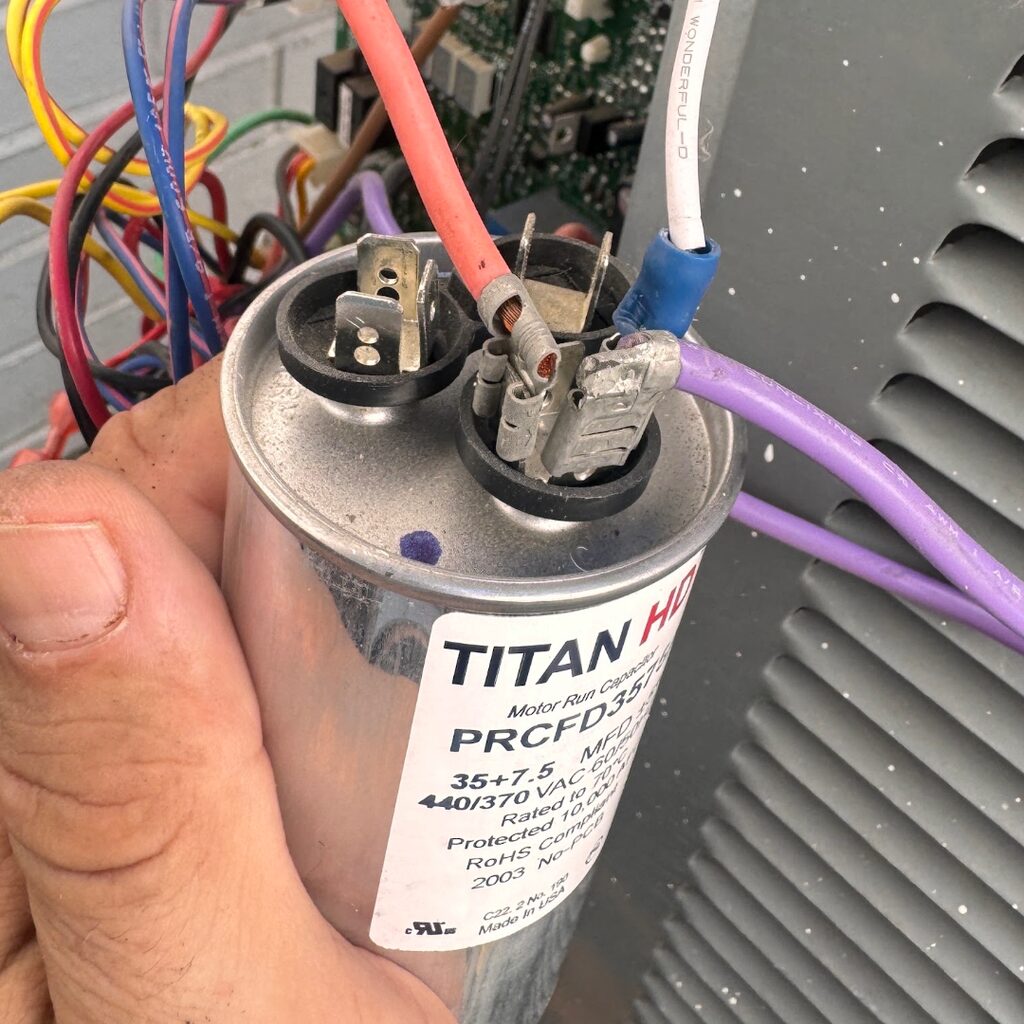
The replacement capacitor must match the HVAC equipment’s required capacitance and voltage specifications.
⚡ The Bottom Line
An AC capacitor is a relatively small electrical component, but it plays an important role in compressor and fan-motor operation.
Common capacitor-failure symptoms include:
🔊 Outdoor unit humming
🌀 Condenser fan not starting
⚙️ Compressor struggling to start
🌡️ AC blowing warm air
🔁 Intermittent or short cycling
⚡ Electrical shutdowns
🎈 Bulging or leaking capacitor
A bad capacitor does not automatically mean you need a new AC system.
But it should be properly tested because many more serious problems can produce similar symptoms.
The objective isn’t simply to replace a capacitor.
The objective is to determine why your AC isn’t working and restore the system to proper operation.
AC Humming or Not Starting in Dallas–Fort Worth?
Airmatics provides professional air-conditioning diagnostics and repair throughout Plano, Frisco, Allen, McKinney, Dallas and surrounding North Texas communities.
If your outdoor AC is humming, the fan isn’t spinning, or the compressor won’t start, our technician can test the capacitor and other electrical components to determine the actual cause.
Schedule AC diagnostic service with Airmatics and get the system properly tested before replacing parts.
Frequently Asked Questions
How do I know if my AC capacitor is bad?
Common symptoms include humming, difficulty starting, an outdoor fan that won’t start, warm air, intermittent operation, or a visibly swollen capacitor. However, the only reliable way to confirm capacitor condition is to test its capacitance against its rated µF specification.
Can an AC capacitor be bad even if it isn’t swollen?
Yes. A capacitor can look completely normal but measure below its required capacitance tolerance.
Can a bad capacitor stop the compressor from starting?
Yes. A weak or failed capacitor can prevent the compressor from starting properly.
Can a bad capacitor stop the condenser fan?
Yes. A failed fan section of a run or dual-run capacitor is one possible reason a condenser fan will not start.
How much does AC capacitor replacement cost?
Published consumer guides vary. Carrier lists approximately $100–$400 for professional replacement, while 2026 Angi data reports an average range around $200–$400 and notes that some flat-rate professional services can be higher depending on local conditions and service timing.
Why is capacitor replacement expensive if the part is inexpensive?
Professional repair includes diagnosis, electrical testing, safe handling, correct part matching, installation, testing of related components, system startup and verification—not simply the physical capacitor.
How long does an AC capacitor last?
Carrier states that capacitors may commonly last approximately 10–20 years, although heat, vibration and operating conditions can shorten their lifespan.
Can I replace an AC capacitor myself?
It is not recommended. Capacitors can retain a dangerous electrical charge even after the HVAC power has been disconnected.
Will a bad capacitor damage my compressor?
Operating a motor with an unhealthy capacitor can place additional electrical and thermal stress on it. Carrier recommends correcting capacitor problems rather than continuing to operate the equipment.
Does a bad capacitor mean I need a new AC?
Usually not. An isolated capacitor failure is generally repairable. The age and condition of the rest of the system should determine whether repair or replacement makes more sense.